Insights · AI in schools · EdTech economics
How I built the AES website in a weekend — and what it tells us about EdTech costs
Two evenings of work. About £40 in tool subscriptions. A site that would have cost a UK agency £25,000 and twelve weeks. What that gap means for the digital projects your school is currently outsourcing.
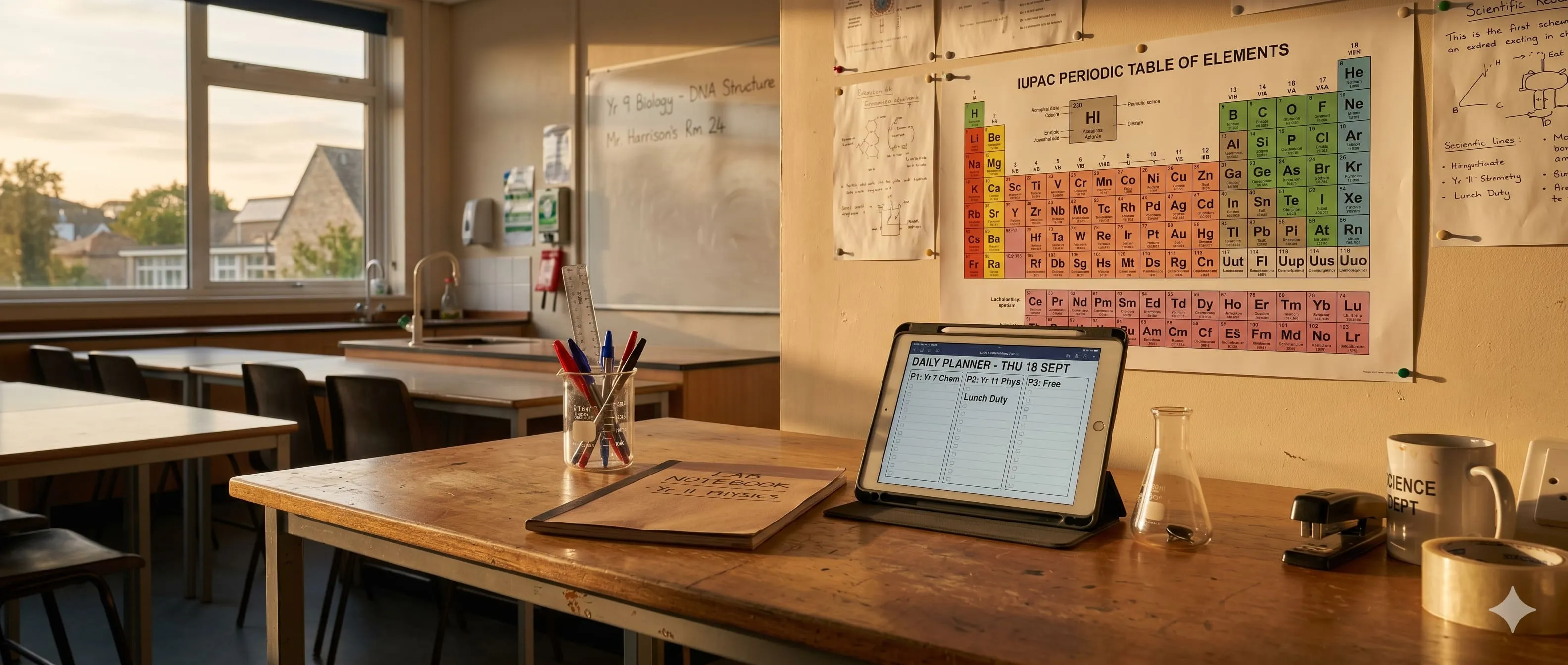
Two evenings ago, this website didn’t exist.
By the end of those two evenings, it had eleven pages, fifteen bespoke editorial photographs, a working email-capture pipeline, two live software demos, a CPD training section, an interactive cost-comparison dashboard, full GDPR-compliant legal pages, and the kind of design system you’d usually see on the homepage of a Series A startup.
Total spend: about £40 in subscriptions.
I’m a science teacher. I lead AI implementation at one school and I deliver CPD on it for others. I’m not a designer, not a developer, and not a copywriter — at least not in the way agencies use those words. The site you’re reading exists because two genuine inflection points met in the same year: AI tools got good enough to do real work, and a single practitioner became capable of orchestrating outputs that used to require an agency.
I want to talk about what that means for schools.
The numbers, briefly
The build comprised seven distinct work categories. Each one would normally be billed by a different specialist or a different agency department. Here’s how the time and cost compare.
| Phase | Agency mid-range | My true cost | Agency time | My time |
|---|---|---|---|---|
| Brand strategy | £5,500 | £0 | 12.5 days | included |
| Design system | £8,000 | £300 | 17.5 days | 2 hours |
| Photography | £2,750 | £75 | 9 days | 30 min |
| Copywriting | £4,000 | £75 | 10 days | folded in |
| Development | £10,000 | £600 | 17.5 days | 4 hours |
| Lead magnet design | £1,300 | £150 | 5 days | 1 hour |
| PM overhead | £6,300 | £0 | 10 days | none |
| Total | ~£37,850 | ~£1,200 | ~84 days | ~8 hours |
The “true cost” column values my time at £150 per hour — what an experienced UK educational consultant would invoice. The raw cost (subscriptions alone) is closer to £40 total. Either way, the order of magnitude is the same: this is a 95-99% reduction.
If you’ve ever sat in a leadership meeting deciding whether you can justify a £20,000 website refresh, that gap should make you stop scrolling for a moment.
See the full live breakdown on /the-numbers.
What you can’t AI your way out of
The temptation, faced with numbers like these, is to conclude that AI has eaten the entire stack. It hasn’t. It’s eaten about 70% of it. The remaining 30% is where the real skill now lives, and it’s worth being honest about.
Three things still required human judgement and could not be delegated:
Knowing what to build in the first place. AI is exceptionally bad at strategy when given a vague brief. The reason this site has a Training section and a Numbers page is because I knew — from eighteen years inside schools — that those were the right arguments to make. An AI given “build me an EdTech site” would have produced something competent and forgettable.
Knowing what good looks like. Editorial photography prompts only work if you know what editorial photography is. Tailwind classes only produce a coherent system if you know typography. The AI didn’t generate the design system; I described it in the language of design, and the AI executed it. That’s a real skill, and it’s still human.
Knowing the audience. Every line on this site is aimed at a specific reader — usually a SENCO, an SLT member, or a Head of Department under specific pressure from the 2026 white paper. AI is bad at this because audience knowledge is local and contextual. I know what an Inclusion Strategy review meeting feels like; the AI doesn’t.
What AI did do, brilliantly, was execute the work once those three things were specified. It wrote the Astro components. It generated the photographs. It drafted the copy that I then edited. It built the cost-comparison dashboard you can see on the Numbers page. It compressed three months into eight hours.
The implication for schools
Here is the part that should matter to you if you run a school or a trust.
You are almost certainly paying for digital work that AI could now do for a fraction of the cost. I don’t mean theoretically. I mean specific things that are currently in your budget right now:
- Website refreshes. The £15,000-£35,000 quotes you get from education-sector agencies are now legacy pricing.
- Bespoke parent-facing tools. Open evening sign-ups, options form interfaces, careers portals — all of these can be built in a weekend by a competent staff member with the right AI training.
- Internal reporting dashboards. That data dashboard the Trust IT lead has been asking for? Two days, not two terms.
- Bespoke teaching tools. Subject-specific revision platforms, retrieval generators, exam preparation interfaces. The Revision Planner that runs at Malmesbury was built by one teacher in a fortnight.
This isn’t a hypothetical. The site you’re reading is the proof. The Revision Planner is the proof. The Feedback Tool launching in September 2026 is the proof.
The skill that schools are now missing isn’t development capacity, or design capacity, or strategy consultancy. It’s the AI orchestration capacity — the people inside the building who can bridge between “this is what we need” and “this is the thing built.” That’s a teachable skill. It looks more like editing and judgement than coding. It can be developed in a couple of CPD days.
What schools should actually be doing
Three concrete suggestions.
First, stop signing off six-figure digital projects without an AI-feasibility review. If a quote crosses your desk for a website, a portal, or a bespoke tool, before approving it ask: could a competent staff member with AI tools build a working version of this in a fortnight? In most cases, the honest answer is yes.
Second, identify your AI-orchestrators and protect their time. Every school has one or two people who would, if given the time and the licence, build genuinely useful things. They’re often classroom teachers with curiosity, not IT staff. Find them. Give them a budget line. Give them an hour a week for six weeks and see what they ship.
Third, invest in capability, not vendors. A £1,500 CPD day teaching a department to use AI well will return more than the same £1,500 spent on a one-off resource purchase. The capability compounds.
I’m aware all three of those suggestions sound self-serving coming from someone selling exactly that capability. They were also true before I started selling it.
Closing
This site cost me one normal subscription and two evenings. It also cost me eighteen years of teaching, an awareness of what schools actually need, and the judgement to know which corners I could let AI cut and which corners I had to defend.
You almost certainly have someone like that on your staff. They might not know it yet.
If you’d like to know what the practical CPD path looks like for getting them productive, the training page has the detail.
— Stuart
Bringing AI into your school?
AES runs online and in-house CPD on AI in secondary schools — where it helps, where it harms, and how to build school-grade tools for a fraction of agency cost.
See training options